How an Appraiser Values a Home
To put it simply, an appraisal is an opinion of value. In New York State, only a licensed or certified appraiser can render such an opinion.
Essentially, an appraiser's objective is to accurately estimate, based on relevant, factual market-derived data, what a typical buyer would expect to pay for a particular piece of real estate at a given point in time.
And typically, the best way to estimate what a buyer would likely pay, is to look at what recent buyers have actually paid for similar properties in the area.
Most often, when dealing with the appraisal of residential real estate (i.e., single family homes, 2 - 4 family properties, as well as individual condo and co-op units), an appraiser's opinion of value is based mainly upon one valuation method, most commonly known as the "sales comparison method."
The Sales Comparison Method
For the purposes of this explanation, it's useful for you to understand that the appraiser will refer to the property being appraised as the "subject property" or the "subject." And he or she will refer to recent sales of similar properties in the subject's market are as "comparables" or "comps."
So, how is the sales comparison approach applied to find the value of a particular piece of real estate?
Simply put, it begins with researching recent sales of properties similar to the subject which are located in the same area or neighborhood as the subject property.
The appraiser then selects several of the most relevant comparable sales (a.k.a. "comps") and begins a process of making value-based adjustments to the actual sale price of each comp.
These adjustments are made to account for significant differences between the subject and each comp. Some examples of significant differences include, dwelling size/square footage, overall condition, amenities, etc.
For a better understanding of this concept, take a look at the following example.
Here's an Example
For example, if the Subject Property was a 1,500 square-foot house and Comp #1 was a 1,300 square-foot house, the appraiser would make an adjustment to the actual sale price of Comp #1 to account for that difference.
Because the Subject Property is bigger, a positive adjustment would be applied to the sale price of Comp #1 to account for value of the difference in size. (See the chart below for an illustration of this example.)
If the Subject Property is in "average" condition and Comp #1 is in "good" condition, the appraiser would make a negative adjustment to the sale price of Comp #1 to account for the value of the difference in condition. (See chart below.)
And to take this one step further, if the Subject Property has 3 bathrooms and the Comp #1 has 2 bathrooms, the appraiser would make a positive adjustment to the sale price of Comp #1 to account for the value of the difference in the number of bathrooms. (See chart below.)
The appraiser will typically apply this method to at least 3, and sometimes as many as 5 or 6 relevant comps.
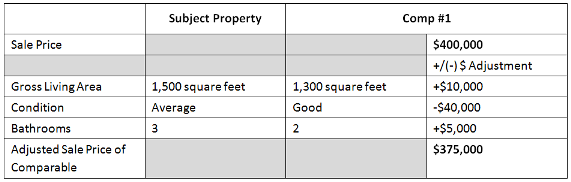
*Above is an extremely oversimplified example which was given purely for the purpose of illustrating the the basic concept underlying the sales comparison approach. Many other factors are taken into account with regard to the value-related differences of the properties analyzed and the numbers used for the value-based adjustments were arbitrarily chosen with the goal of simplicity in mind.
The Final Opinion of Value
After this process has been applied, the adjusted sale price of the comps analyzed should all end up in a relatively narrow range once the appraiser has applied this method to them. From that point, the appraiser will reconcile those numbers to arrive at an opinion of value for the subject property based upon this approach.
Once that is done, the appraiser will reconcile that number with several other market-related considerations to arrive at a final opinion of value for the subject property.
We have 5 Local Appraisal Offices Serving Long Island and New York City - Call Us Today!
- Nassau
- (516) 642-4369
- Suffolk
- (631) 479-3141
- Queens
- (718) 355-9697
- Brooklyn
- (718) 313-0902
- Manhattan
- (212) 256-1908



Our real estate opinions and expertise have been featured in...




-
"The appraiser was knowledgeable, honest and very helpful"
"Our experience with Appraisal Source was excellent. Starting with the initial phone call, the appraiser was knowledgeable, honest and very helpful. The appraisal was thorough, professional and the finished documents were exactly what our town required. Our appraiser was very reliable, answered all our questions and helped us understand all aspects of the appraisal process. We have recommended Appraisal Source to several of our friends and all have been extremely satisfied."
- Rocco & Maryellen Comitino
Commack, NY -
"Your report was very definite and very complete"
"Thank you so much for sending the appraisal. You did an excellent job and I was very impressed with the details and thoroughness of your report. Your report was very definitive and very complete. While we are aware that the appraisal is not a final determination of the sale price of the house, your objective evaluation gave us a realistic view of the true value of the property. Thank you!"
- Janet Daley
Mineola, NY -
"I would recommend you enthusiastically to anyone"
"Recently you appraised a condo that my husband and I were interested in buying. Given the crazy real-estate market, we knew we could not trust the appraisal that would be provided by a lender, so we wanted a truly independent appraisal. As neither of us had a clue how to go about finding and appraiser in NYC, we simply turned to the Internet. Picking someone from the web always seems to be a chancy proposition. However, in this case our choice was excellent. In every way you impressed me with your professionalism and knowledge. You returned my initial call promptly. You arrived on time. You did a very through job at in inspecting the condo. At the end, my daughter did her best to get you to give a "ballpark" estimate on the spot, but I was very pleased to see that you insisted that you could not provide a meaningful estimate until you had all the information in hand. We received the appraisal report 3 days after the appraisal and it was extremely detailed. And all this for a very reasonable price. I would recommend you enthusiastically to anyone I know who needed an appraisal in NYC."
- Sarah Lenington, PhD
Brooklyn, NY -
"I was very pleased with the quality of your services"
"I was very pleased with the reliability, efficiency, and professional quality of your services. If I hear of anyone who needs the service you provided to me, I would certainly highly recommend a call to your office."
- Susan Penzer
Manhattan, NY -
"We will highly recommend you to all our friends and family"
"I just wanted to take a moment to thank you for all your help and professionalism.We will highly recommend you to all our friends and family whom might need such excellent services from Appraisal Source. EXCELLENT SERVICE!!!:):):)"
- Gregory & Tara Cespites
Lindenhurst, NY -
"Your appraisal saved us money and a future financial disaster"
"The service was really valuable and I would recommend it to my friends and family. Your appraisal saved us money and a future financial disaster. Thank you."
- Dulce Tamares
Queens Village, NY -
"You did a very thorough appraisal of my home"
"I was very pleased with your appraisal services. You acted in a professional manner and did a very thorough appraisal of my home. I would not hesitate to recommend your services to any of my neighbors or friends."
- Bob Toolan
Floral Park, NY -
"Saved me from potentially making an over-valued purchase"
"Thank you for the very thorough appraisal you recently conducted for me. It saved me from potentially making an over-valued purchase."
- David S.
Manhattan, NY -
"The photographs, research and presentation was flawless"
"We appreciate all you have done to help lower our taxes. We were very impressed with your professionalism and thoroughness. The photographs, research and presentation was flawless. We will and have recommended Appraisal Source for any and all appraisal needs."
- Mari Catalanello
Holbrook, NY -
"It was a pleasure doing business with you"
"Just a note to thank you for providing me with excellent service regarding my real estate appraisal. Your company not only provided me with a professional appraisal, but it also did so in a manner that fulfilled all my requests and expectations willingly. As a result of your genuine efforts, it was a pleasure doing business with you, and I would recommend your services enthusiastically."
- Bob Taormina
Melville, NY